
Climate-Related Risks and Disasters: Implications for Financial Stability and Inclusion
January 17, 2023


The topic of climate-related risks and disasters has become more salient for policymakers and communities as the threat of climate change affects places and people across the United States, particularly those who are geographically or socially vulnerable to these shocks and stressors. Climate-related risks and disasters are important to consider for a stable and inclusive economy, as ongoing climate changes may lead to more intense frequent, prolonged, or repeated risks and disasters.1
In this Partners Update article, the Community and Economic Development team in the Atlanta Fed's Sixth District2 considers the implications of climate-related risks and disasters. For purposes of this article, we refer to climate-related risks and disasters as risks to human and natural systems that may lead to more severe and frequent shocks or stressors. For the southeastern states that we cover, the combination of higher-than-national-average poverty and increased geographic vulnerability to climate-related risks and disasters warrants further exploration to find innovative and applicable household- and community-level resilience solutions.
Why is considering climate-related risks and disasters important for a stable and inclusive economy?
Climate-related risks and disasters may create or exacerbate vulnerabilities in households, businesses, and economies that can lead to financial hardship or unfavorable economic conditions through chain reactions.
In its 2020 annual Financial Stability Report,3 the Board of Governors of the Federal Reserve System noted that climate change, or the increase in average global temperatures and resulting environmental impact, "adds a layer of economic uncertainty and risk" and "is likely to increase financial shocks and financial system vulnerabilities that could further amplify these shocks."4 Stated differently, climate-related risks have the potential to produce adverse economic outcomes for everyone.
What characteristics make the Southeast especially vulnerable to physical and social climate-related risks and disasters?
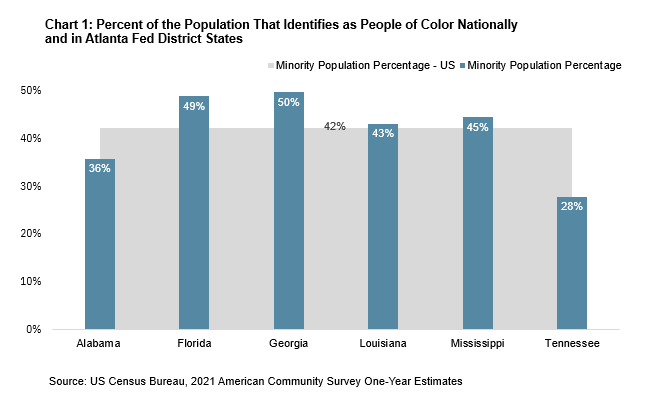
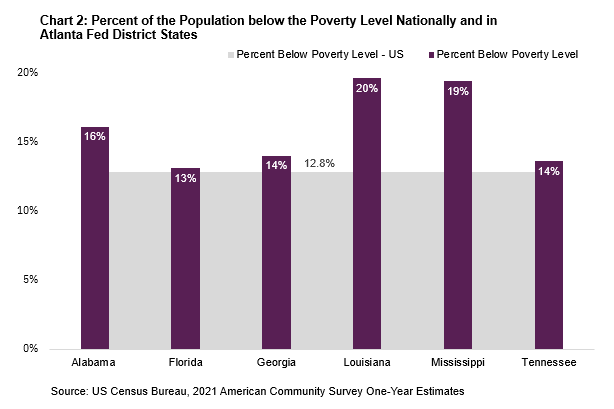
As we demonstrate, the Atlanta Fed's southeastern states are particularly vulnerable to climate-related risks and disasters, which tend to be more economically disruptive for socially vulnerable populations, including people who are lower-income, people of color, people without a high school diploma, and people who are 65 and older.5 We illustrate in charts 1 and 2 the percent of our District state population who are people of color and those below the poverty level compared to national averages to identify possible increased climate-related and disaster risks due to these vulnerabilities.
According to 2021 National Risk Index data from the Federal Emergency Management Agency (see chart 3), several states in the Atlanta Fed's District have hazard risk scores6 that met or exceeded those of the United States.7 Furthermore, Florida, Louisiana, and Mississippi have particularly elevated hazard risk scores, making parts of the Atlanta Fed District relatively more vulnerable to climate-related risks and disasters and their economic repercussions than other parts of the country.
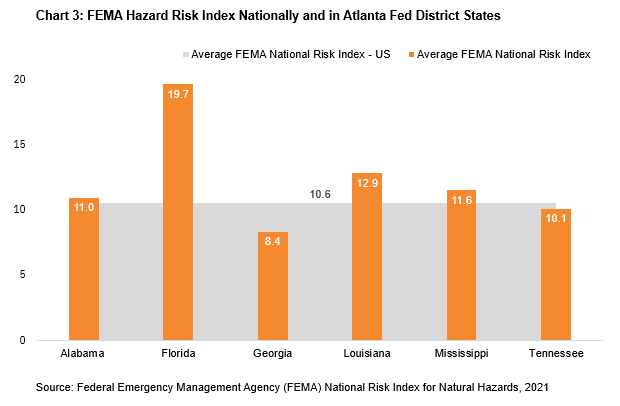
As climate-related risks and disasters are expected to accelerate and intensify,8 the economic risks to households and communities may, in turn, be exacerbated, particularly for low- and moderate-income households and communities of color who tend to be at disproportionate risk.9 The presence of greater shares of at-risk populations in a concentrated geography is why climate-related risks and their potential impacts on the economic well-being of communities in the Southeast are of particular interest to the Atlanta Fed's Community and Economic Development program.
What's next?
The Atlanta Fed is committed to tracking barriers to, and elevating opportunities for, the economic mobility and resilience of people and places across the Southeast. Climate-related risks and disasters are one such potential barrier.
As the Community and Economic Development team seeks to understand the implications of climate-related risks and disasters for low- and moderate-income households through our research and engagement activities and initiatives, we will also assess how our findings can inform the Bank as it pursues its mission and performs its core functions.
For questions about climate risks and community development, please reach out to Dontá Council at donta.council@atl.frb.org or Charly van Dijk at charlene.vandijk@atl.frb.org.
- 1 US Global Change Research Program. 2018. Impacts, Risks, and Adaptation in the United States: Fourth National Climate Assessment, Volume II.
- 2 The Atlanta Fed encompasses Alabama, Florida, Georgia, and parts of Louisiana, Mississippi, and Tennessee.
- 3 The annual Financial Stability Report provides a detailed assessment of the resilience of the US financial system.
- 4 Board of Governors of the Federal Reserve System. November 2020. Financial Stability Report, page 58.
- 5 US Environmental Protection Agency. 2021. Climate Change and Social Vulnerability in the United States: A Focus on Six Impacts.
- 6 Risk Index scores are presented as a composite score for all 18 hazard types, as well as individual scores for each hazard type. In this article, we use the composite score at the state level. All scores range from 0‒100. For more information, visit Determining Risk.
- 7 Federal Emergency Management Agency. 2021. "The National Risk Index."
- 8 US Global Change Research Program. 2018. Impacts, Risks, and Adaptation in the United States: Fourth National Climate Assessment, Volume II.
- 9 US Environmental Protection Agency. 2021. Climate Change and Social Vulnerability in the United States: A Focus on Six Impacts.