
Atlanta Fed Fosters Interest in Economics among College Students
August 15, 2023

Apueela Wekulom and Brooke Pearson describe their college internships at the Atlanta Fed as helping them decide on pursuing a doctoral degree in economics.
Wekulom is certain she wants to earn a PhD in economics so she can help alleviate poverty in French-speaking countries. The only question facing the 2023 graduate of Georgia Tech, who earned a bachelor of science degree with highest honors in economics and international affairs, is whether to first earn a master's degree in data analytics or data science. "I'm insecure about math," she said.
Pearson, a senior majoring in business management at Georgia State University, is sure she won't seek a PhD in economics after her expected graduation in 2024. Though Pearson had considered the degree to further her interests in data research, her experience at the Atlanta Fed helped her realize that pursuing a career as an entrepreneur, possibly in retail, is her true desire.
Wekulom and Pearson participated in one of the programs the Federal Reserve Bank of Atlanta supports to introduce college students to career opportunities in economics and finance. The Atlanta Fed is especially attuned to spreading this message among women and historically disadvantaged minorities, two groups underrepresented in the field, according to reports including a 2022 paper by the American Economic Association.
In addition, diversity is a requirement of Section 342 of the Dodd-Frank Wall Street Reform and Consumer Protection Act of 2010. It requires each of the 12 Federal Reserve Banks to "take affirmative steps to seek diversity in the workforce of the agency at all levels of the agency."
The Atlanta Fed's outreach efforts intend to connect with students who may have not considered a future in economics or finance. Atlanta Fed president Raphael Bostic portrays these efforts as part of the Fed's expansion of its talent search.
"The Fed, for a long time, went to the usual suspect places and then got the usual suspects back," Bostic told students of two historically Black colleges and universities (HBCUs) during a February 8 panel discussion. "If we want to have a different set of people, we've really got to be more creative about where we try to source our talent and then nurture that talent as they come in."
These longstanding concerns about outreach efforts have grown with a rising awareness of the lack of diversity among PhD recipients in terms of family income, parental education, and parental occupation. Economics is "the least socioeconomically diverse of any major field for US- [and foreign-]born PhD recipients" and diversity has worsened over the past 20 years, according to a 2022 working paper by the Peterson Institute for International Economics that parsed data from the National Science Foundation's Survey of Earned Doctorates.
Aware of this, the Atlanta Fed supports programs that intend to inform college students about opportunities in the fields of finance and economics. Not all will choose a career in the fields, as in Pearson's case. Nor is that the programs' intent, as Bostic observed in an example about interns who help with a research enterprise.
"The goal there is not to get everyone to love it, but just get everyone to know it," Bostic said during the HBCU event in February.
As an example of the Atlanta Fed's efforts, its Research Division supports various opportunities for interns to experience the work done in the fields of finance and economics. Examples include:
- Campus outreach. In addition to giving occasional presentations (upon request) in classrooms, staff pilot two outreach programs. One is the Economics Collaborative in the Atlanta-Area Academic Institutions, or Eco3AI. The second pilot program, Diversifying the Economic Education Pipeline (DEEP), operates out of the Atlanta Fed's Nashville Branch and links students interested in economics with mentors affiliated with the National Association for Business Economics.
- HBCU quantitative curriculum. The Atlanta Fed partners with students at the Atlanta University Center Consortium, a nonprofit association of four HBCUs, to conduct econometric analysis.
- Predoctoral research analyst. Positions are open to those who are interested in pursuing a PhD in economics but not required to be in a program when they are partnered with Atlanta Fed economists to pursue research analysis.
These programs, some still in their pilot stages, continue to evolve as sponsors identify improvements.
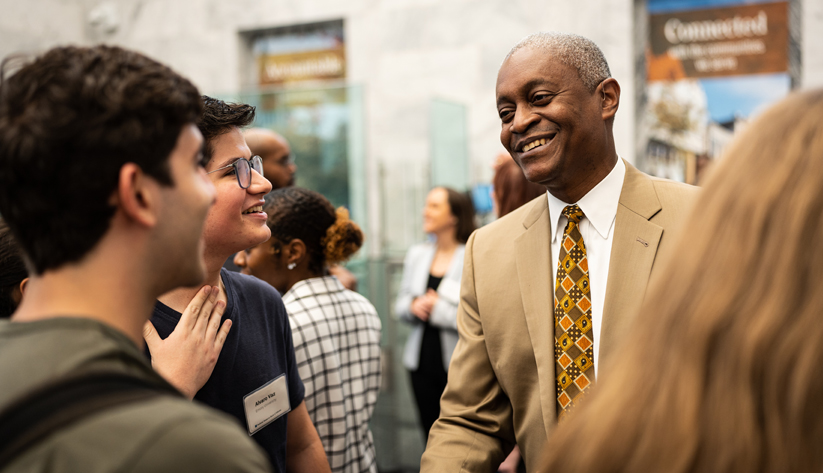
The Eco3AI campus outreach program ended its two-year run in April with a networking event hosted at the Atlanta Fed. Up to 150 graduates and undergraduates from 10 universities mingled with 17 professors, nearly 30 business professionals, and Atlanta Fed officials. Bostic shared his experiences as an economist, including his selection as the first Black and gay Reserve Bank president in the Federal Reserve System. The Bank's top two researchers, chief economic adviser Dave Altig and executive vice president and director Paula Tkac, also talked about their pathways to a career in economics.
The celebration culminated a series of 10 virtual events at which students moderated panel discussions among leaders from private industry, nonprofits and government. Professors and student leaders of their schools' economic clubs coordinated the events in conjunction with the Atlanta Fed. The first was titled "Econ Degrees: What Are These Things Actually Good For?"
"Most of us don't know what an economist does," said Peter Kower, an economics professor at Oglethorpe University who helped organize Eco3AI. Students learned that the field is far larger than the stock market and money. "It's economists who address environmental issues in fact-based, quantitative ways. It's labor, to explain income disparities," Kower said.
Students mingled in their first in-person networking event. Previously, gatherings had been limited by pandemic concerns.
"I was smiling ear to ear," Pearson said after the event. "Although I sometimes am an introvert, I thought it important to attend and make a connection with people, to laugh in person, and just understand more of them and their story."
Emily Adams, a rising senior at Georgia Tech majoring in economics and international affairs, listened as Bostic, a PhD economist, described his journey to becoming an "economist by accident" and finding "a job that challenges me every day." She wondered how doctoral candidates select their areas of focus.
Wekulom's approach is to network everywhere. Her outgoing personality is part of her background as a native of Nigeria who moved with her family to Illinois when she was two and to Stockbridge two years later. Wekulom commended her professors for responding to her request for help, an outreach that was suggested in an Eco3AI event. "Without them, I don't know what I would have done," Wekulom said.