
Connecting to Economic Opportunity: The Digital Divide in the Southeast
August 17, 2023

- Partners Update
- Publication
- Community and Economic Development
- Workforce Development
- Regional Economy

Introduction
High-speed internet, commonly referred to as broadband,1 is an integral part of the modern, digitally dependent economy. Access to at-home broadband connects users to health care and educational services, banking and e-commerce platforms, and employment opportunities. However, as broadband infrastructure has become available to communities across the United States, the digital divide—the uneven distribution of broadband service and adoption—has emerged as a barrier to inclusion in the economy. Those without broadband internet service, disproportionately people living in rural and low- and moderate-income communities, rely on internet connections such as dial-up and cellular internet such as 2G and 3G that are slow and unreliable for accessing modern digital information networks.
In previous research from the Philadelphia Fed, Sánchez and Scavette (2021) found strong correlations between broadband subscription rates, regional poverty rates, and labor market attachment indicators, particularly labor force participation and the unemployment rate at the metropolitan statistical area level.2 This research showed that US metro areas with low broadband subscriptions and computer access were disproportionately in the Southeast and Southwest. In this Partners Update article, we update Sánchez and Scavette's research with the most recent data from the American Community Survey (ACS) and focus on the states in the Federal Reserve System's Sixth District: Alabama, Florida, Georgia, Louisiana, Mississippi, and Tennessee.
First, we show state-level variation in access to broadband and cellular data service and in the availability of home computers. Second, we present findings that show consistent state-level differences in prime-age labor force participation between workers with and without a broadband-enabled computer. For all six states, we find relatively large disparities in median income between groups with and without a broadband-enabled computer. Moreover, we find geographic concentrations of households in rural areas that have low rates of broadband subscription and elevated levels of poverty. Finally, the analysis shows that Black and Hispanic individuals are less likely than White and Asian individuals are to have a broadband-enabled computer at home. It is important to stipulate that this analysis does not causally link access to a broadband-enabled computer with labor force participation. We provide descriptive summary statistics that suggest a possible correlation between these variables and other demographic indicators as a starting point for further discussion.
Note that the Atlanta Fed does not provide funding for grants or programs, nor does it select grant recipients or program participants. The Atlanta Fed does not provide investment advice of any type.
Broadband subscription and other digital access by state
In table 1, we report variations in the share of households in Sixth District states and nationally with access to the internet, cellular data service, rates of laptop or desktop access at home, and broadband subscription rates. These household-level statistics were calculated using the ACS Public Use Microdata Sample (PUMS) 1-Year estimates for 2021. Across the Sixth District states, between 85 percent and 94 percent of households reported that they had access to the internet, which may not be provided at broadband speeds, either with or without paying through an internet service provider (ISP). Cellular data plans for a smartphone or mobile device were slightly less common than internet in all states, but still fairly widespread among Sixth District households, ranging from 76 percent to 85 percent. Household access to laptops or desktops was even lower, ranging from 67 percent to 82 percent. In Mississippi, Louisiana, and Alabama, over 25 percent of households lacked an at-home computer.
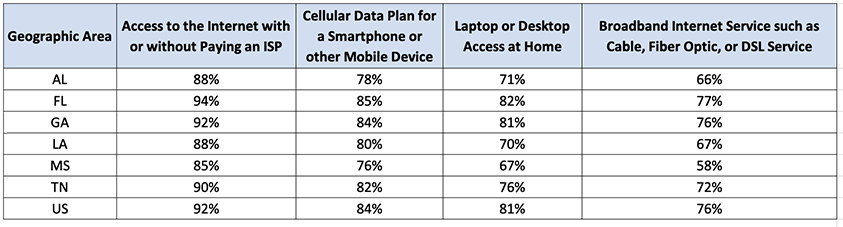
Source: Author's calculations using ACS PUMS 2021 1-Year Estimates
Note: All statistics presented in Table 1 are household-level estimates.
Broadband internet subscriptions through a fixed wireline connection to the home—such as cable, fiber optic to the premises, or digital subscriber line—were the least common form of internet service relative to the other available options. Broadband subscription rates were lowest in Mississippi, Alabama, and Louisiana (58 percent, 66 percent, and 67 percent, respectively). While many people use cell phones to connect to online resources, the share of individuals who are smartphone-only internet users is declining, indicating that a growing share of people use a combination of at-home internet service along with their cell phones.3 Indeed, wireless service cannot fully provide the benefits of an at-home connection, given its reliability constraints, data usage caps, and limited data processing speeds.4 Therefore, we focus on access to computers with fixed-wireline broadband connections, such as cable modem, fiber optic to the home, and digital subscriber line services.
Labor force participation and demographic indicators by broadband access
Table 2 shows the labor force participation rates for workers with and without a broadband-enabled computer in the Sixth District states and the United States overall. The table also includes the unemployment rate, poverty rate, median income, median age, and a share of the population by race and ethnicity with and without access to a broadband-enabled computer. Across all states, the prime-age (25–54 years old) labor force participation rate is lower for individuals living in a household without access to a broadband-enabled computer, relative to individuals with access. Three states in particular, Louisiana (66 percent), Mississippi (69 percent), and Alabama (69 percent), have the lowest labor force participation rates for people without an at-home broadband-enabled computer. Unemployment rates for workers without a broadband-enabled computer are slightly higher in every state relative to those with access. Moreover, individuals with access to a broadband-enabled computer have lower poverty rates higher median incomes, and a slightly lower median age compared to workers without access. Lastly, in each state we report disparities in access to a broadband-enabled computer by race and ethnicity. Consistently, a larger share of Black and Hispanic individuals living in the Sixth District lack access to a broadband-enabled computer relative to White and Asian people. In states like Louisiana, Mississippi, and Alabama, over one in three Black and Hispanic individuals lack access to high-speed internet and a laptop or desktop.
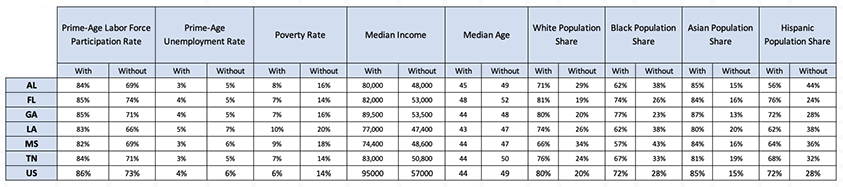
Source: Author's calculations using ACS PUMS 2021 1-Year Estimates
Note: All statistics presented in Table 2 are population-level estimates.
Although table 2 reports descriptive statistics that highlight disparities based on access to a broadband-enabled computer, these data are simply descriptive of trends. We do not establish a causal relationship between access to a broadband-enabled computer and labor force participation or other indicators. We also do not control for other factors that influence labor force participation or unemployment.
County-level analysis of broadband access and poverty status
The map below is a bivariate choropleth map5 of counties in Alabama, Florida, Georgia, Louisiana, Mississippi, and Tennessee. We use the ACS five-year estimates from 2017 to 2021 to create this map because one-year estimates were not available in areas with fewer than 65,000 people.6 The shading of the legend indicates the intersection and variation between the share of households without a broadband subscription (ranging from 4 percent to 63 percent) and the poverty rate (ranging from 4 percent to 47 percent) of each county. Across the region, the map shows clear geospatial concentrations of households without a broadband subscription and high poverty rates. South Georgia and Alabama and much of Louisiana and Mississippi have relatively high poverty rates and low broadband subscription. Notably, the Southeast counties that have relatively lower broadband subscription and higher rates of poverty are the region's more rural parts. Counties with the highest rates of poverty and largest share of households without a broadband subscription (shaded in dark purple) have a predominantly rural population: 82 percent of the population in these areas live in nonmetropolitan counties.7
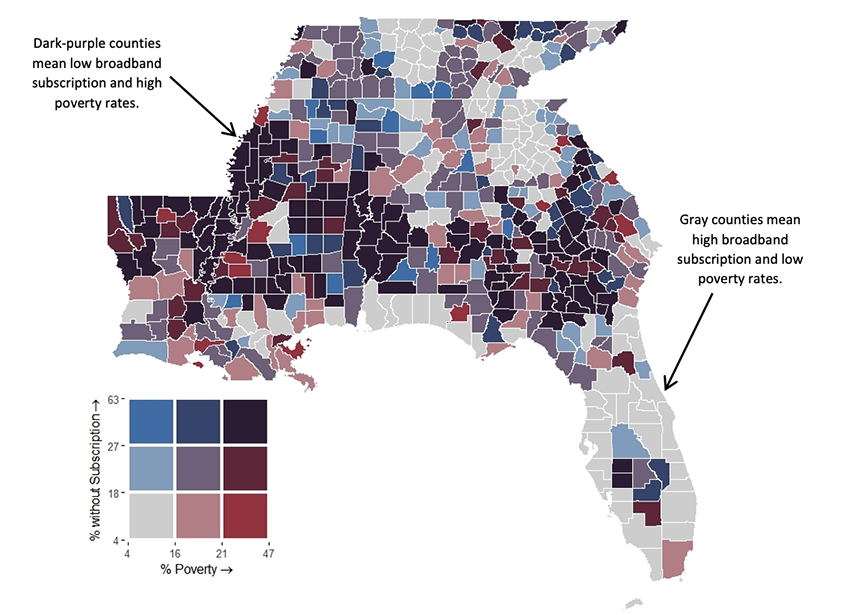
Source: American Community Survey 5-Year Estimates (2017–2021), table S2801
Discussion
Disparities in broadband and computer access may hinder economic opportunity across the Southeast. Our results are consistent with findings from the literature indicating a connection between access to broadband and labor market attachment indicators. A 2015 survey by Pew Research Center found that 71 percent of Americans believed that living without an at-home broadband connection would create a major or minor disadvantage for finding jobs and gaining skills. The same survey found that job seekers without broadband access would find it more difficult to create résumés, contact employers, and fill out online job applications than those with broadband access at home.8
Another study found that at-home or publicly available broadband, like what would be available at a library, reduces the probability that an unemployed person would stop their job search by up to 50 percent relative to unemployed individuals without access to a broadband connection.9 Due to data limitations, we do not capture in our analysis whether people without at-home broadband make use of publicly available internet. Additional research has shown that broadband infrastructure expansion is associated with employment growth in technology-reliant industries and geographic regions with lower population density10 as well as stable employment relationships following unemployment.11
While the analysis presented here does not establish a causal link between access to a broadband-enabled computer and labor force participation, it serves as a starting point for discussion and future research. The apparent relationships we find between access to a broadband-enabled computer and labor force participation point to the impacts that the digital divide could have on workers in the Southeast, including workers in rural households and Black and Hispanic people. Additionally, rigorous analyses with timely data would help us understand the full extent of the digital divide's impact on employment outcomes, particularly among historically underserved populations. Such research can inform policy and practice, including cross-sector discussions and partnerships. For example, state governments are currently creating five-year digital equity plans for Broadband Equity and Deployment (BEAD) Program funding. Plans will receive public comment before their implementation in late summer or early fall of 2023. Conversations around broadband-related funding can benefit from data on the place-based and economic dynamics of the digital divide.
Learn more about how to participate in your state's BEAD Program comment process.
The views expressed here are the author's and not necessarily those of the Federal Reserve Bank of Atlanta or the Federal Reserve System. Any remaining errors are the author's responsibility.
- 1 The Federal Communications Commission defines broadband internet as any connection that provides download speeds of at least 25 megabits per second (Mbps) and 3 Mbps download speeds. However, higher download and upload speeds are often necessary to operate small businesses (50 Mbps+), schools (100 Mbps–1,000 Mbps+), and hospitals (1,000 Mbps+). See "What Speed Do You Need?" BroadbandUSA, 2017. https://broadbandusa.ntia.doc.gov/sites/default/files/publication-pdfs/bbusa_what_speed_do_you_need.pdf.
- 2 Alvaro Sánchez and Adam Scavette. Broadband Subscription, Computer Access, and Labor Market Attachment across U.S. Metros. (Federal Reserve Bank of Philadelphia, 2021). https://www.philadelphiafed.org/community-development/workforce-and-economic-development/broadband-subscription-computer-access-and-labor-market-attachment-across-us-metros.
- 3 Pew Research Center reports that the majority of Americans own a smartphone (85 percent) or a cell phone (97 percent), and just 15 percent of the adult population use only a smartphone without an at-home broadband connection. See "Internet/Broadband Fact Sheet." Pew Research Center: Internet, Science & Tech, April 7, 2021. https://www.pewresearch.org/internet/fact-sheet/internet-broadband/.
- 4 Thompson, Larry, Brian Enga, Brian Bell, and Warren Vande Stadt. "Comparing Wired and Wireless Broadband." Broadband Communities, May 2015. https://www.bbcmag.com/pub/doc/BBC_May15_ComparingWiredandWireless.pdf.
- 5 A choropleth map uses a color scheme across a predefined geography that indicates variation in variable values.
- 6 "When to Use 1-Year or 5-Year Estimates." Census.gov, August 25, 2022. https://www.census.gov/programs-surveys/acs/guidance/estimates.html.
- 7 Nonmetropolitan counties, a common definition of rurality, are based on the 2013 Rural-Urban Continuum Codes. See "Rural-Urban Continuum Codes." USDA ERS - Rural-Urban Continuum Codes, December 10, 2020. https://www.ers.usda.gov/data-products/rural-urban-continuum-codes/.
- 8 Aaron Smith. "Lack of Broadband Can Be a Key Obstacle, Especially for Job Seekers." Pew Research Center blog, December 28, 2015. https://www.pewresearch.org/short-reads/2015/12/28/lack-of-broadband-can-be-a-key-obstacle-especially-for-job-seekers/.
- 9 T. Randolph Beard, George S. Ford, Richard P. Saba, and Richard A. Seals Jr. "Internet Use and Job Search." Telecommunications Policy 36, no. 4 (2012): 260–73.
- 10 Jed Kolko. "Broadband and Local Growth." Journal of Urban Economicss 71, no. 1 (2012): 100–113.
- 11 Manudeep Bhuller, Andreas Kostol, and Trond Vigtel. "How Broadband Internet Affects Labor Market Matching." Available at SSRN 3507360 (2019).