
Beige Book: Despite Ongoing Uncertainty, Glimmers Appear in Commercial Real Estate, Trucking
July 15, 2026


The Southeast economy continued to grow modestly through late May and June, according to the new Beige Book from the Federal Reserve Bank of Atlanta.
The Federal Reserve's mandate from Congress is to pursue price stability and maximum employment. In those realms, conditions were broadly unchanged from recent months.
On the price stability front, business contacts continued to report high fuel and transportation costs, and they noted big price increases in petrochemical products such as resins and adhesives as the Middle East conflict wore on. Meanwhile, fertilizer costs continued a steep climb, and farm equipment prices have tripled in some cases, adding to manifold woes facing farmers.
In commercial construction, the rapid build‑out of infrastructure for artificial intelligence technologies intensified demand for materials, contributing to supply constraints and resulting in higher prices for steel, transformers, and other machinery. On the consumer side, restaurateurs and retailers said their ability to raise prices was limited by price-sensitive customers.
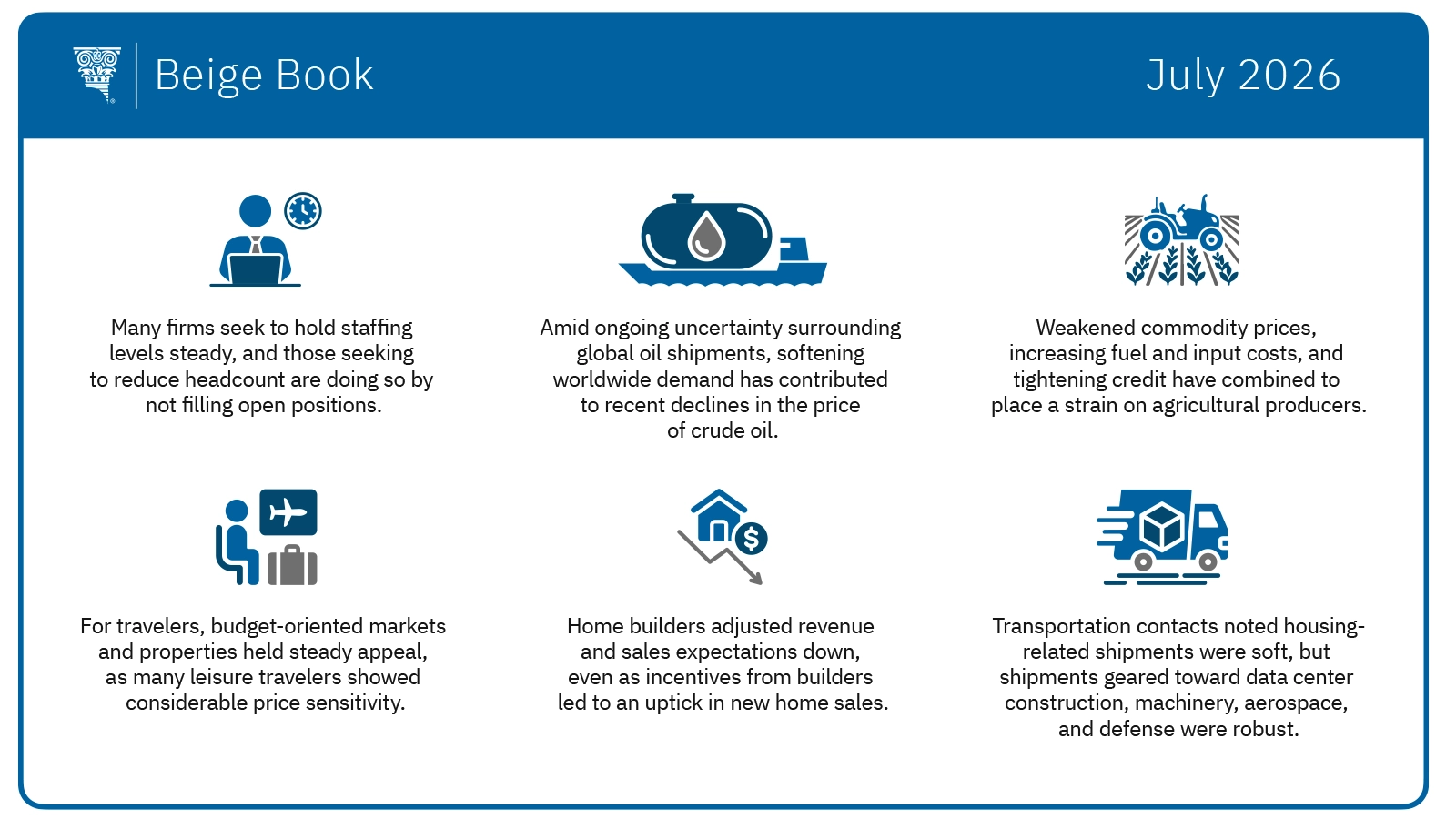
On the labor market front, employment levels were flat to slightly down as most firms continued to keep staffing level or trim the ranks, mainly by not filling open positions. Reports of layoffs remained limited. Although reports of AI use spread, most contacts said they don't expect AI to cause significant job cuts soon.
- Energy industry conditions remained stable despite the conflict in the Middle East. Firms continued to report rising input costs affecting both oil production and oilfield services, pressuring operating margins. Several contacts noted that softening global demand contributed to recent crude oil price declines, although most emphasized that ongoing uncertainty surrounding the Strait of Hormuz disrupted shipments and kept inventories tight.
- The district's agricultural producers continued to face adversity on several fronts. Multiple contacts reported weak prices for the commodities they produce, rising input costs, and tightening credit. Row‑crop farmers faced particular financial strains amid high fuel costs, along with tariffs and international market shifts that depressed soybean prices.
- Tourism activity in the District grew modestly, in part because of World Cup soccer games in Miami and Atlanta. Although those events supported hotel and short-term rental performance in their markets, many leisure travelers elsewhere remained highly price conscious, fueling steadier demand in budget-oriented markets and properties. Luxury and upscale travel remained strong.
- In financial services, an increase in short-term personal loans or "buy now, pay later" financing hinted at ongoing household financial strain. Commercial and industrial lending declined, and contacts noted that many businesses deferred investment in the face of ongoing economic and geopolitical uncertainty.
- Incentives from home builders led to an uptick in new home sales, but economic uncertainty and rising mortgage rates resulted in builders adjusting revenue and sales expectations downward, streamlining operations, and reducing labor costs.
- In commercial real estate, vacancy rates in Class A space fell into single digits for the first time since 2020. Contacts noted a shift toward reducing office size in favor of upgraded amenities.
- Trucking brokerages reported volumes exceeding year-earlier levels for the first time since 2021. Growth in freight shipments was centered in data center construction, machinery, aerospace, and defense, while housing-related shipments remained soft. The tighter trucking market and high energy prices helped railroads as shippers converted to rail transport.
The Beige Book is a Federal Reserve System publication about current economic conditions across the 12 Federal Reserve districts. The Fed System and regional reserve banks publish the Beige Book eight times a year, before each meeting of the Federal Open Market Committee. The reports from each District characterize regional economic conditions based on a variety of mostly qualitative information, gathered directly from District sources, including interviews and online questionnaires completed by businesses, community organizations, economists, market experts, and other sources. The Committee next meets July 28 and 29.