
From Barrier to Bridge: Approaches to Address Benefits Cliffs
August 04, 2026


Workforce Currents 2026-03
Digital Object Identifier: https://doi.org/10.29338/wc2026-03
What is a benefits cliff?
Working families can experience a variety of financial barriers that limit economic mobility. One significant barrier occurs when career advancement puts a family above the income-eligibility threshold for public assistance programs. Career advancement, and the wage gains that come with it, can create a scenario in which a family is financially worse off due to the partial or complete loss of benefits–a phenomenon known as a benefits cliff. In other instances, the loss of benefits may largely erase (but not entirely offset) the financial gains associated with career advancement, a dynamic known as a benefits plateau. Both situations can curtail economic mobility.
In this hypothetical scenario, follow a single mother with two children living in Davidson County, Tennessee. Her family participates in the Supplemental Nutrition Assistance Program (SNAP), Medicaid for Children (CHIP), and the Housing Choice Voucher (HCV, also known as Section 8) program. She also qualifies for the Child Tax Credit (CTC), and the Earned Income Tax Credit (EITC). As you can see in figure 1, when employment income increases (left to right on the horizontal axis), benefits phase out before disappearing completely at various income eligibility thresholds. While some phaseouts are gradual, others are rather sudden and can result in a large drop in net resources (income plus benefits minus taxes and expenses). Because these cliffs and plateaus can vary significantly depending on household composition and geographic location, they have traditionally been difficult for both individuals and lawmakers to identify and address (you can explore potential benefits cliffs in other communities via the Federal Reserve Bank of Atlanta's Policy Rules Database Dashboard).
Figure 1
Net Financial Resources by Employment Income. Net Financial Resources Equals Income Plus Benefits Less Taxes and Less Expenses
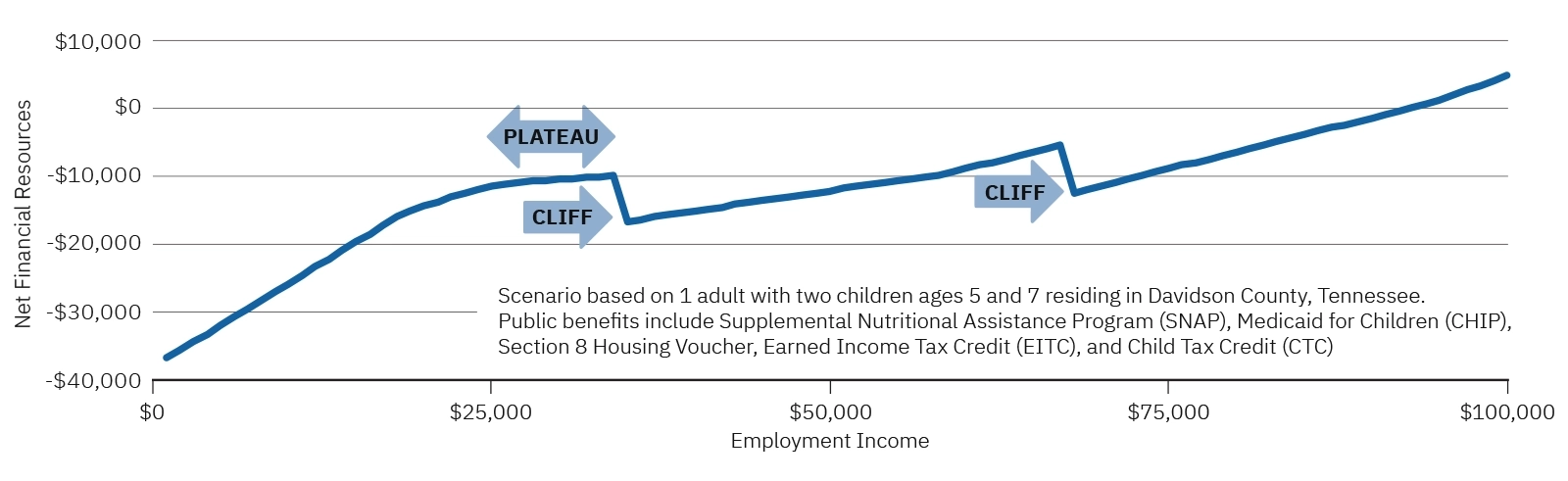
Crucially, the real or perceived threat of experiencing a benefits cliff is not uncommon among workers. A nationally representative survey, for example, found that more than one in five workers who receive public benefits have taken actions such as turning down hours at work or refusing job offers and promotions to avoid encountering benefits cliffs that can wreak havoc on household finances.1
In recent years, benefits cliffs have become more prominently identified as a disincentive to career advancement for low-income working families. In response, state and local governments, workforce and social service providers, and employers throughout the country are investing in solutions to address this challenge for the populations they serve and employ. These efforts include policy changes to directly reduce and eliminate benefits cliffs as well as innovation pilots to test new approaches to mitigate benefits cliffs. This publication serves as a summary of the various mitigation approaches and related resources that might be instructive for communities and states that are starting to identify strategies to address benefits cliffs.
How policymakers mitigate the benefits cliffs problem
The prevalence and complexity of benefits cliffs have led to a growing number of states working to better understand and address the issue. According to the National Conference of State Legislatures (NCSL), for example, since 2021 eight states and the District of Columbia have established committees to study the impact of benefits cliffs and explore options to address them.2 Similarly, the American Public Human Services Association (APHSA) has developed a resource hub outlining policy changes in twelve states, including detailed state profiles. In the Northeast, the Whole Family Approach to Jobs initiative developed a report documenting the learnings and actions of six New England states to address benefits cliffs.3 Additionally, the Council of State Governments has summarized various state approaches to public assistance policy changes that mitigate benefits cliffs.4
Establishing formal legislative committees to study benefits cliffs is typically the first step taken by states looking to address the issue. While these states are all typically focused on eliminating benefits cliffs as an impediment to economic mobility, specific areas of focus can vary. In some states, including Montana and New Hampshire, studies have largely focused on simply illustrating to lawmakers how benefits cliffs can negatively impact economic opportunity for families and potentially contribute to workforce shortages for employers.5 In other states, legislative work has focused on specific programs such as Temporary Assistance for Needy Families (TANF) or those serving persons with disabilities like Supplemental Security Income (SSI). Massachusetts recently published a report examining how benefits cliffs impact the employment decisions of individuals with disabilities.6 Still other states have explored how the benefits cliffs issue intersects with other policy issues, such as Vermont's increase in the minimum wage.7
State progress on benefits cliffs is often iterative. For example, in 2021, the Kentucky legislature passed legislation creating a workgroup to assess the feasibility of implementing a bridge health insurance program to help individuals that lose Medicaid eligibility and cannot readily afford private marketplace coverage. The legislation also called for a review of TANF expenditures to identify opportunities to improve economic mobility.8 The following year, additional legislation called for a number of steps: the development of a benefits cliff calculator; the establishment of a pilot program; and the creation of a benefits cliff task force to conduct a comprehensive study of benefits cliffs in Kentucky and make recommendations to assist benefit recipients in transitioning to work and new career opportunities.9
After examining the benefits cliffs issue, several states followed Kentucky's lead and moved to adopt benefits cliff calculators as a cost-effective means of helping workers and job seekers make better informed decisions. Much like the exploratory efforts themselves, states have employed various strategies to promote the deployment of benefits cliff calculators. In Florida, for example, the state legislature passed a bill in 2024 requiring the state's workforce board to mandate the use of a benefits cliffs tool demonstrating future financial impacts of changes to benefits and income in client counseling sessions.10 In 2023, South Carolina passed similar legislation.11 In Alabama, the Governor's Office launched DAVID, a benefits cliffs calculator to assist case managers and help career coaches assist workforce clients.12 In Louisiana, the Board of Regents was instrumental in the adoption of a benefits cliffs calculator.13 In Tennessee, the state workforce board is piloting a benefits cliffs calculator with plans to use the tool in all American Job Centers by the end of 2026.14 The Federal Reserve Bank of Atlanta provided its no-cost CLIFF suite of tools to each of these five states that adopted benefits cliffs calculators.
In addition to mandating the use of benefits cliffs calculators, states have also adopted broader policy changes aimed at mitigating potential cliffs. The approaches include income disregards (a policy by which specific amounts of money are excluded for program eligibility determination), changes in asset limits, and implementation of a graduated phase out so that a modest increase in earnings doesn't lead to a more substantial reduction in benefits.
Income disregard policies are commonly adopted by states to reduce the prevalence and severity of benefits cliffs. This is especially true in the administration of TANF due to the program's flexibility. According to an analysis by the National Center for Children in Poverty, a dozen states have increased earned income disregard for TANF eligibility during the past 20 years.15 Indiana, for example, exempts up to $15,000 in increased earnings once a household has been determined eligible for TANF assistance in an effort to encourage increased employment while avoiding benefits cliffs.16 Instead of focusing on specific numerical increases in earnings, other states have established income disregards on a time-limited basis. Maine, for instance, disregards 100 percent of earned income during the first three months of employment that began while an individual was participating in TANF.17 Other states exempt educational grants and other forms of financial aid from TANF considerations.18 Such policies are intended to ensure that workers pursuing a postsecondary degree, an apprenticeship, a new, better-paying job, or other paths toward economic mobility aren't blocked by potential benefits cliffs.
Asset disregards are another tool states have utilized to lessen the impact of benefits cliffs. Given the wide latitude states have in setting limits for both TANF and SNAP, these two programs have seen the greatest number of innovations in removing asset limits as a contributing factor to benefits cliffs. Some states such as Connecticut and Rhode Island have recently increased TANF asset limits.19 Other states such as Colorado and Massachusetts eliminated asset limits altogether. Nearly 40 states also exempt at least one automobile from TANF asset test considerations.20 As a result of broad-based categorical eligibility (BBCE), a policy in which households may become categorically eligible for SNAP because they qualify for other social assistance programs, states that reduce or eliminate asset tests for TANF may simultaneously reduce or eliminate asset tests for SNAP. Because of BBCE, only a handful of states maintain SNAP asset limits.21
Graduated phaseouts are another avenue available to states looking to address benefits cliffs. One example is related to childcare subsidies. The main federal program available to help families pay for childcare, the Child Care and Development Fund (CCDF), limits eligibility to families with income at or below 85 percent of the state's median income (SMI).22 Once a family's income exceeds 85 percent of SMI, in many states they hit a steep cliff given the high cost of childcare. Some states, however, have implemented supplementary programs with graduated phase outs to assist families earning more than 85 percent of SMI. Florida's School Readiness Plus program, for example, provides support to families with earnings up to 100 percent, with families incrementally paying more toward the cost of care as income increases.23 Other states with similar assistance programs include Maine and Vermont.
Innovations in benefits cliffs mitigation
Across the country, state and local governments, workforce development agencies, and social service providers are piloting dozens of innovations. The Beyond the Cliff coalition, led by the Martha O'Bryan Center, is bringing more than 70 of these practitioners, including state and local governments and nonprofit providers, to share promising practices and build the evidence base for what works. While each of these interventions takes a distinctive approach to supporting families navigating benefits cliffs, common themes include transitional assistance, stabilization funds, and resource coordination.
Transitional assistance
Transitional assistance directly addresses benefits cliffs by providing resources that fill the gaps created by lost benefits while families continue to work toward long-term financial stability. While this is a common intervention across innovation pilots, there is notable variation in how transitional assistance is delivered.
Some pilots provide assistance that is proportionate to benefits lost due to increased earnings. Pilots with this approach include Our Chance TN, a TANF-funded partnership of the Tennessee Department of Human Services and Martha O'Bryan Center, which provides transitional assistance, replacing cliffs with a more gradual reduction as earnings increase.24 Another is DC Department of Human Services' Career MAP, which is focused on families that have experienced homelessness and are receiving housing assistance. The program provides transitional assistance by prorating rent to negate other benefit reductions.
An alternative approach involves regular fixed payments that supplement the transition off benefits. When exiting TANF, participants in the Onondaga County Department of Social Services' 2Gen Onondaga initiative receive a cash payment equal to their TANF benefits for 12 months, followed by 50 percent of that amount for an additional year.25 The Workforce Development Council of Seattle-King County has seen promising results from a series of pilots that provided participants in workforce programs between $500 and $1,000 per month in cash payments that also made benefits counseling available to participants.26
Additionally, while not a direct transitional benefit, some pilots offer financial incentives tied to the achievement of milestones that support economic mobility. The Ohio Department of Job and Family Services, for example, has adopted this approach in partnership with several counties through its Benefits Bridge pilot program. Participants can earn up to $8,000 to help offset reductions in benefits elsewhere.27
Stabilization funds
Several innovation pilots have identified the importance of stabilization funds for addressing emergency or critical unmet needs, such as overdue rent or car repairs, that would otherwise derail economic mobility efforts. Based on learnings from a pilot, the Office of Workforce Development in Hennepin County, Minnesota, has begun to require its benefits cliffs intervention grantees to offer flexible funding to participants to address barriers that would otherwise prevent economic advancement.28 Working with a limited budget, rather than offering direct transitional assistance, Episcopal Community Services of Philadelphia designed an effective benefits cliffs intervention focused on meeting emergency needs that arise as a result of the loss of benefits.29
Resource coordination
Resource coordination within innovation pilots takes many forms. But the common thread is leveraging additional services and supports to holistically support families as they seek to advance economically. Some pilots also employ this approach to supplement transitional assistance and stabilization funds, although this can be constrained by the availability of community resources. Many pilots add wraparound supports such as mental health support (for example, 2Gen Onondaga, DC CareerMAP), financial counseling (for example, 2Gen Onondaga, Ohio Benefit Bridge, Our ChanceTN), and social capital building (for example, 2Gen Onondaga, Circles) that further support families as they seek to increase earnings and navigate benefits cliffs. Our ChanceTN has even created dedicated resource navigator positions in each county it serves to identify and coordinate resources to meet participant needs such as housing, healthcare, childcare, and transportation.
Future issues and needs for benefits cliffs mitigation
As the myriad policy advancements and innovation pilots suggest, there is growing interest nationwide in addressing the benefits cliffs issue. In addition to government and non-profit stakeholders, employers themselves are beginning to try to mitigate benefits cliffs to more effectively support incumbent workers as they increase earnings. Goodwill of the Southern Piedmont, for example, partnered with regional employers to embed benefits cliff coaching directly in the workplace.30 Similarly, the Georgia Center for Opportunity's BETTER WORK initiative combines community resources, employers, and benefits cliff coaching to help low-wage workers advance economically.
Additionally, states that have previously adopted benefits cliffs mitigation policies continue to deepen their involvement in this space. Tennessee, for instance, hopes to build upon the momentum of the community and state innovation efforts with a new pilot that will integrate benefits cliffs counseling tools into American Job Centers and track worker outcomes. Together, these pilots may ultimately lay the foundation for subsequent statewide initiatives and inform activities far beyond Tennessee.
Both community- and state-led efforts highlight the reality that identifying and deploying potential benefits cliffs mitigation approaches remains an area rich with innovation, as well as one rife with questions that could benefit from further understanding and research. For example, while the reality of benefits cliffs is well documented, identifying how the perception of benefits cliffs impacts behavior is less clear. Additionally, while much work has been done on assessing the immediate impact of benefits cliffs on workers and their families, the longer-term intergenerational impacts are less understood. It is also vital to continue emphasizing administrative data to identify mobility gains among pilot participants.
Ultimately, these issues underscore the twin realities of benefits cliffs mitigation efforts: while much progress has been made, there remains significant opportunity to advance economic mobility among today's working families.
Comments to the corresponding author are welcome at brittany.birken@atl.frb.org.
The views expressed here are those of the authors' and not necessarily those of the Federal Reserve Bank of Atlanta or the Federal Reserve System. Any remaining errors are the authors' responsibility. The Federal Reserve Bank of Atlanta's Community and Economic Development function supports the Central Bank's mandate of stable prices and maximum employment by helping improve the economic opportunity of low- and moderate-income (LMI) individuals and underserved places for a stronger economy for all Americans. Community development is one of the Federal Reserve's core functions and this responsibility is rooted in its mandates from Congress. Our Workforce Currents series addresses emerging and critical issues in workforce development. Find more research, use data tools, and sign up for email updates at Community & Economic Development.
- 1 Steven Roll, Selina Miller, and Mathieu Despard, "The Impact of Benefits Cliffs and Asset Limits on Low-Wage Workers: New Evidence from a Nationally Representative Survey," CSD Research Brief No. 25-07. Washington University, Center for Social Development. Accessed May 26, 2026.
- 2 National Conference of State Legislatures, "Introduction to Benefits Cliffs and Public Assistance Programs," Updated December 27, 2024.
- 3 Whole Family Approach to Jobs Initiative, "New England States Tackle Benefit Cliffs: Cultivating Innovation to Support Family Economic Mobility," Accessed May 26, 2026.
- 4 The Council of State Governments, "Living on the Edge," Updated October 26, 2023.
- 5 See Erin Sullivan, "Benefits Cliffs," Montana State Legislature Economic Affairs Interim Committee, September 2021, and New Hampshire Department of Health and Human Services, "Benefits Cliff Working Group Cliff Effects Final Report," September 3, 2021.
- 6 David Jan and Mark Rembert, "Report on Disability Benefit Cliff Effects in Massachusetts," Executive Office of Labor and Workforce Development Department of Economic Research, March 2025.
- 7 Vermont General Assembly, "Report of the Minimum Wage and Benefits Cliff Study Committee," Vermont Legislative Joint Fiscal Office Minimum Wage and Benefits Cliff Study Committee, December 2017.
- 8 Kentucky General Assembly, "House Joint Resolution 57: A Joint Resolution Directing the Cabinet for Health and Family Services to Establish a Work Group to Assess the Feasibility of Implementing a Bridge Insurance Program, to Review Current Temporary Assistance for Needy Families Expenditures, and to Consider Opportunities for Public-Private Partnerships to Better Meet the Needs of Public Assistance Beneficiaries," 2021 Regular Session.
- 9 Ibid., "House Bill 708: An Act Relating to the Public Assistance Benefits Cliff," 2022 Regular Session.
- 10 Florida House of Representatives, "House of Representative Staff Analysis–Bill CS/CS/HB 1267 Economic Self-Sufficiency," February 8, 2024.
- 11 South Carolina General Assembly, "Statewide Education and Workforce Development Act, A67, R84, H3726," May 17, 2023.
- 12 Bob Farley, "Alabama, Atlanta Fed Partner on New Workforce Development Resource," Alabama Business Journal, November 6, 2020.
- 13 Louisiana Board of Regents, "Louisiana Prospers: Driving Our Talent Imperative, Master Plan Summary, 2021 Year 2 Review."
- 14 Tennessee State Workforce Development Board, "State of Tennessee State Workforce Development Board Meeting Minutes," November 14, 2025.
- 15 National Center for Children in Poverty, "A 50-State Comparison of TANF Policy Settings Linked to Child and Family Protection," March 23, 2024.
- 16 Representatives Chuck Goodrich, Dale DeVon, Cindy Ledbetter, and Cherrish Pryor, "House Bill 1009: TANF Program," Indiana General Assembly, Session 2021.
- 17 Elissa Cohen, Erika Huber, and David Kassabian, "Welfare Rules Databook: State TANF Policies as of July 2013, Final Report," OPRE Report 2014-52, The Urban Institute, September 2014.
- 18 See the National Center for Children in Poverty, "Health and Human Services Committee, One Hundred and Seventh Legislature, 2021 and 2022 Sessions," May 26, 2026, and Massachusetts Law Reform Institute, "SNAP Eligibility Rules/Rights for College Students," February 12, 2026.
- 19 See the Whole Family Approach to Jobs Initiative, "New England States Tackle Benefit Cliffs–Cultivating Innovation to Support Family Economic Mobility," Accessed May 26, 2026, and Divya Nair and Jessica Vega, "Temporary Assistance for Needy Families and Rhode Island Works Policy Brief," The Economic Progress Institute and Rhode Island Kids County, May 2025.
- 20 Katharine French-Fuller, "State Level Options to Mitigate Benefit Cliffs," Accessed May 26, 2026.
- 21Ashley Burnside and Jesse Fairbanks, "Eliminating Asset Limits: Creating Savings for Families and State Governments," Center for Law and Social Policy, October 2023.
- 22 Karen Lynch, "The Child Care and Development Block Grant: In Brief," Congressional Research Service, December 3, 2024.
- 23 Florida Department of State, "School Readiness Plus Program, Rule: 6M-9.200," Florida Administrative Code and Florida Administrative Register, September 24, 2024.
- 24 Gabriella Chiarenza, "Investing in community expertise, Tennessee takes on the benefits cliff," Fed Communities, August 29, 2023.
- 25 Sarah Easterly, Deputy Commissioner, Onondaga County Department of Social Services, email communication with authors, July 11, 2026.
- 26 Workforce Development Council of Seattle-King County, "How Flexible Financial Support Is Opening Doors to Economic Mobility," July 16, 2025.
- 27 American Public Human Services Association, "Benefit Cliff Mitigation in Ohio," June 2025.
- 28 Suad Maow, Principal Planning Analyst, Hennepin County, Minnesota, email communication with authors, July 24, 2026.
- 29 Episcopal Community Services, "Addressing the Benefits Cliff," August 2025.
- 30 Mecca Howe and Bridget Anderson, "Benefits Cliff Employer Pilot Program EvaluationOverview and Strategies for Employers," Goodwill Industries of the Southern Piedmont, February 20, 2025.