
Researchers Seek Answers to South Florida's Home Affordability Strains
October 09, 2026



Although population growth in the Miami metro area has slowed over the last year, the large influx of residents from 2020 to 2025 has fueled a housing shortage. During this period, the population of Miami metro area grew by 4.9 percent, increasing the population by more than 350,000. This growth compared to a 3.7 percent growth rate in population for the US as a whole during the same period, according to Moody Analytics estimates. This population surge helped make the prices of homes, for either purchase or rent, beyond the means of most area residents and outside the definition of affordable housing applied by the US Department of Housing and Urban Development (HUD). For homeowners, the situation is compounded by escalating costs for property insurance and taxes as well as assessments by homeowner associations.
Two data points reveal why the Miami metro area remains one of the least affordable housing markets, both in the region and nationally:
- To own a home, a household would need to make nearly twice the actual median income in the region (which stands at $84,479) for their housing costs to represent less than 30 percent of annual income, the rate recommended by the federal government.
- Middle-income renter households in the Miami-Fort Lauderdale-West Palm Beach area earn between $74,000 and $111,000 annually, yet 60 percent of them experience housing cost burden, meaning the cost exceeds 30 percent of their income.
This type of information, and more, is available from the Atlanta Fed's tools. The Home Ownership Affordability Monitor measures the ability of a median-income household to absorb the estimated annual costs associated with owning a median-priced home. The Southeastern Rental Affordability Tracker demonstrates the number of southeastern renter households that pay more than 30 percent of their income on housing costs.
The Home Ownership Affordability Monitor (HOAM)
The increase in home prices was not matched by a comparable increase in household income, resulting in near-record-low home ownership affordability. The Atlanta Fed's HOAM shows that a household making the median income in Miami ($85,483) would need to spend 60 percent of its annual income to own the median-priced home in the region ($534,333)—well above the 30 percent affordability threshold recommended by HUD (see figure 1).
Figure 1: Median versus Qualified Income in Miami-Fort Lauderdale-West Palm Beach
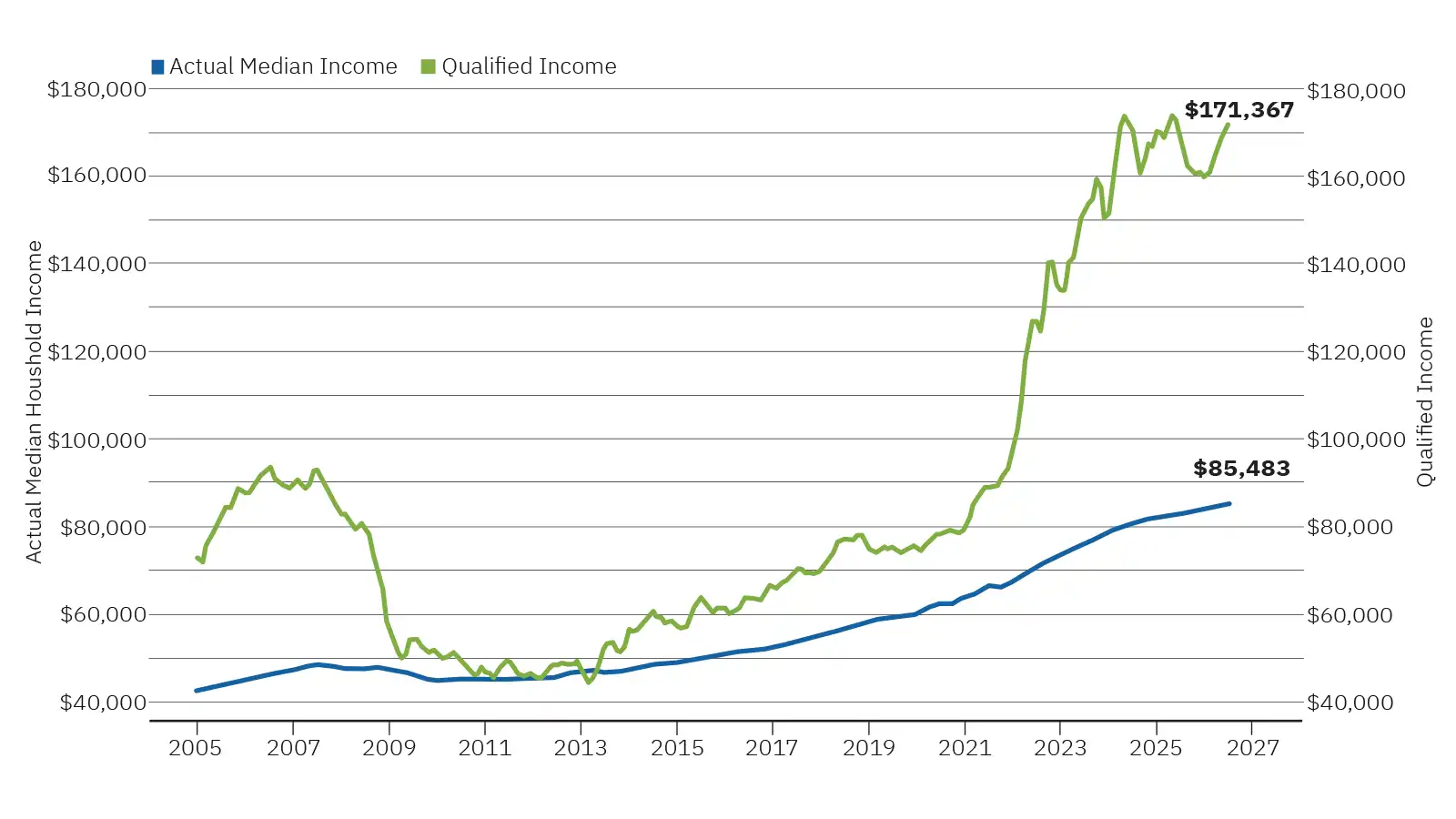
Note: Qualified Income is the annual income needed to own the median-priced home without exceeding the 30 percent share of income affordability threshold.
Put into concrete terms, owning the median-priced home in the region while not spending more than 30 percent of annual income would require a household to make $171,367 per year (i.e., qualified income)—nearly double the actual median income in the region. Miami remains one of the least affordable housing markets in the Southeast and, indeed, in the nation.
The Southeastern Rental Affordability Tracker
Although recent and potential homeowners feel the burden of rising housing costs, rental alternatives don't provide meaningful affordability relief. Across the Miami-Fort Lauderdale-West Palm Beach metro area, nearly 60 percent of all renters are cost-burdened (see figure 2), meaning that it takes more than 30 percent of their income to pay for housing—levels that exceed national ones. (Nationally, nearly half of all renters are cost burdened, according to Harvard University's recent publication, America's Rental Housing 2026.)
Figure 2: Overall Cost Burden in Miami-Fort Lauderdale-West Palm Beach
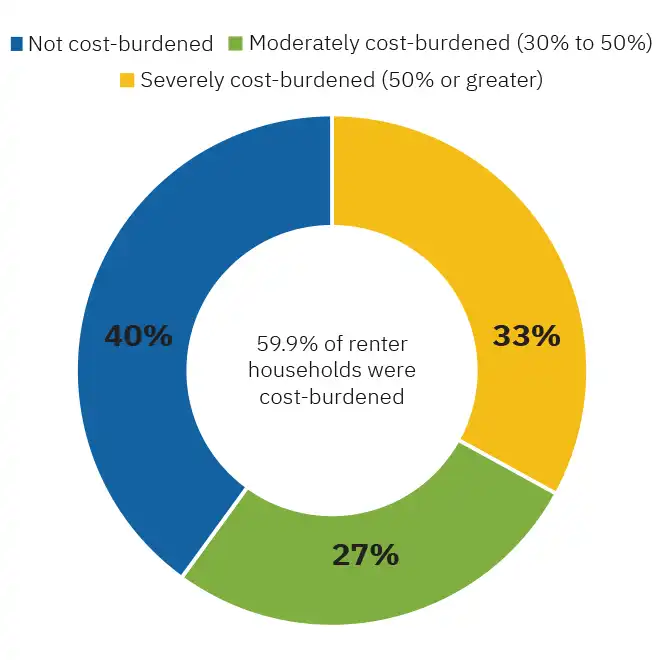
As figure 2 shows, more than 33 percent of Miami-area renter households face a severe cost burden, spending more than half their income on rent. In Miami, low-income renter households—those earning around $74,000 or less for a family of four—81 percent spend more than a third of their earnings on rent. (Low-income households earn at or below 80 percent of the area median income, or AMI.) Among Miami's middle-income renter households—which earn around $74,000 to $111,000 annually, or between 80 percent and 120 percent of AMI—60 percent experience housing-cost burden. Comparatively, only 19 percent of upper-income renter households (those earning 120 percent of AMI and above) experience housing-cost burden.
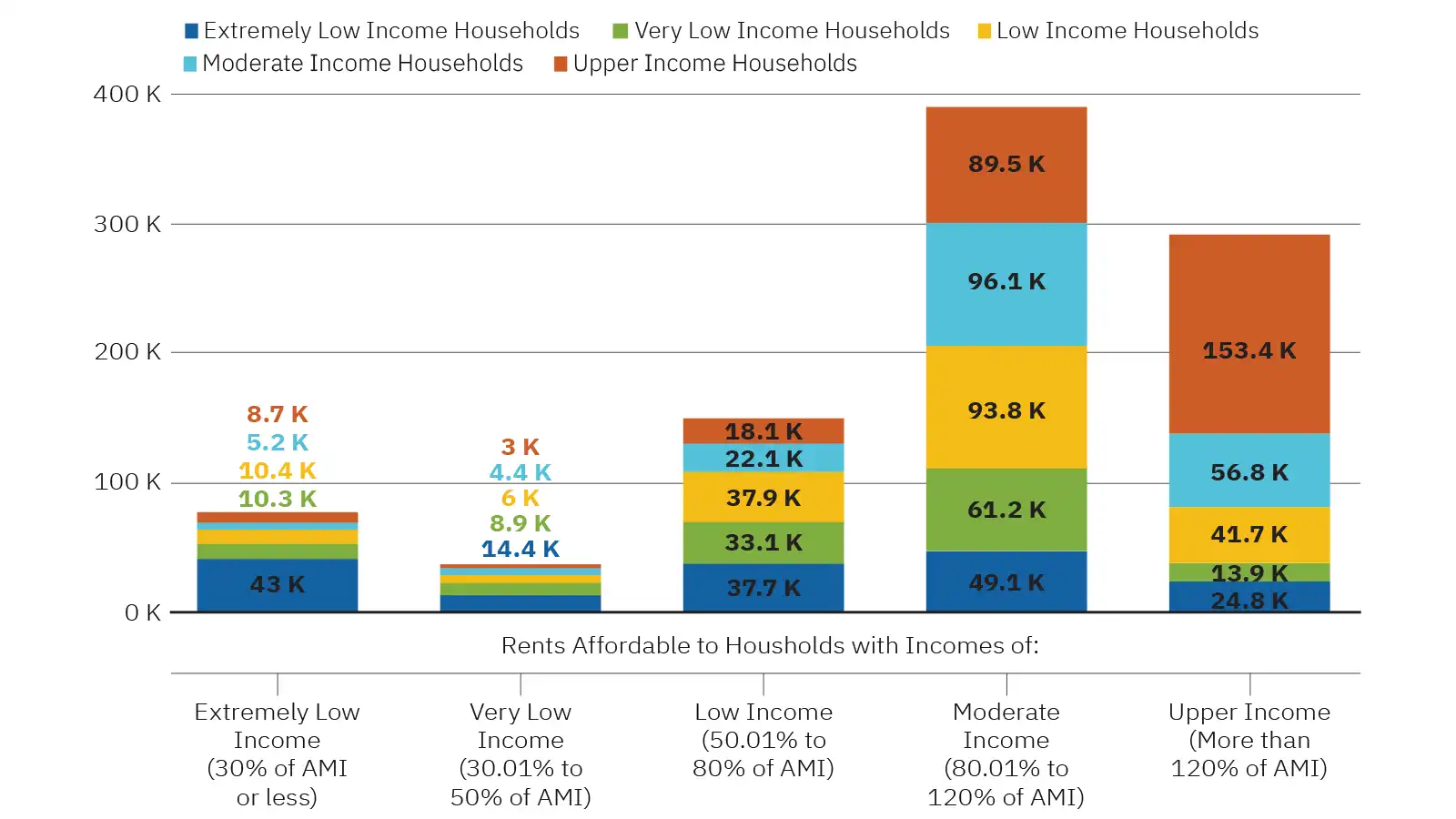
Figure 3 illustrates the number of rental units by different affordability levels (along the x axis), the color-coded bars showing the actual household income of the occupants of those units. In short, it illustrates the imbalance between rental prices and occupant incomes. In the Miami metro area, 47 percent of upper-income renter households (the red bands) live in rental homes that are priced affordably for households below that income level. Compared to the Atlanta Fed's district, a far larger share of the Miami area's rental housing stock is priced for moderate- and upper-income households, but because lower-cost housing is not available, lower-income households are occupying higher-cost housing. As the figure demonstrates, more extremely low-income households (0–30 percent of AMI, depicted in the blue bands) occupy homes priced at levels affordable to households earning 80–120 percent of AMI than occupy any other price range of unit, including those priced more affordably. Only about a quarter of the units that are priced affordably to individuals earning 50–80 percent of AMI are occupied by households within that income band. You can read more from the Atlanta Fed about this issue in "Where Are the Affordable Rental Units?".
Figure 3: Rental Unit Affordability by Occupying Renter Household Income
Florida legislative initiatives
Florida legislators and housing advocates have recognized challenges that have hindered opportunities for housing affordability and living arrangements that, in effect, have posed barriers to local economies. Housing researchers and policymakers often target affordability barriers that limit the increase of supply, such as zoning, density limits, or unit size minimums. In recent years, Florida policy makers have tried to make it easier to build affordable multifamily homes across the state through the Live Local Act and other legislation.
One prominent issue has been rising costs of insurance, property taxes, and home owners association (HOA) assessments in the state and, particularly, in south Florida. A closer look at HOAM for Miami-Fort Lauderdale-Palm Beach reveals that these costs collectively have increased 150 percent over the last ten years. However, these costs have moderated during the last year, with peak median costs in July 2025 of $4,310 declining to $3,980 in January 2026.
In March 2023, House Bill 837 was signed into law, initiating tort reform and aimed at numerous lawsuits and settlements with major insurers. Prior to this legislation, many insurance carriers exited the state, leaving homeowners with few insurance options and very high premiums. Some homeowners opted to limit their insurance coverage or forgo insurance altogether. Since this legislation passed, eleven companies have entered the Florida property insurance market, leading to rate reductions or flat renewal premiums for insured Florida homeowners, according to the Florida Chamber of Commerce. Acknowledging these changes, Florida Bankers Association CEO Kathy Kraninger says, "New carriers are coming into the market. They are aligning with the business communities and consumers to roll back these increases."
On the HOA side, the passage of Senate Bill 4-D/HB 913 in the wake of the Surfside condominium collapse in 2021 affected Florida condominium owners. This legislation required structural inspections to fully fund reserves by 2025, and in some cases leading to special assessments per unit exceeding $100,000. This requirement had particular impact on some senior residents living on fixed income and presents barriers to market entry. Some efforts to ease the impact of this legislation with delayed assessments have been made, such as those noted in this Atlanta Fed article.
Opportunities to increase public-private partnerships will help make homeownership and rental housing more attainable for Florida residents. Kraninger cites state Sen. Kathleen Passidomo's , designed to create opportunities for workers to live near their jobs. This legislation increases funding for housing programs, provides funding for new rental units, gives incentives to renovate older programs, and increases tax credits to encourage Florida businesses to contribute to community development and housing projects for low-income households.
Increasing housing market supply could relieve cost pressures and result in greater affordability for some households. As recent studies by the Pew Charitable Trust and the Georgetown Center on Poverty and Inequality show, increasing affordability for low-income households means supply-side efforts need to focus both on preservation and increased supply of dedicated affordable units.
For further reading:
Horowitz, Alex, and Tushar Kansal. 2023. "Survey Finds Large Majorities Favor Policies to Enable More Housing," The Pew Charitable Trusts, November 30.
Kansal, Tushar, and Alex Horowitz. 2025. "State Legislatures Make Bipartisan Breakthroughs on Policies That Promote Housing," The Pew Charitable Trusts, September 15.
Schuetz, Jenny. 2020. "To improve housing affordability, we need better alignment of zoning, taxes, and subsidies." Washington, DC: Brookings Institution.
———. 2023. "How can state governments influence local zoning to support healthier housing markets?." Cityscape 25, no. 3 (2023): 73–98.